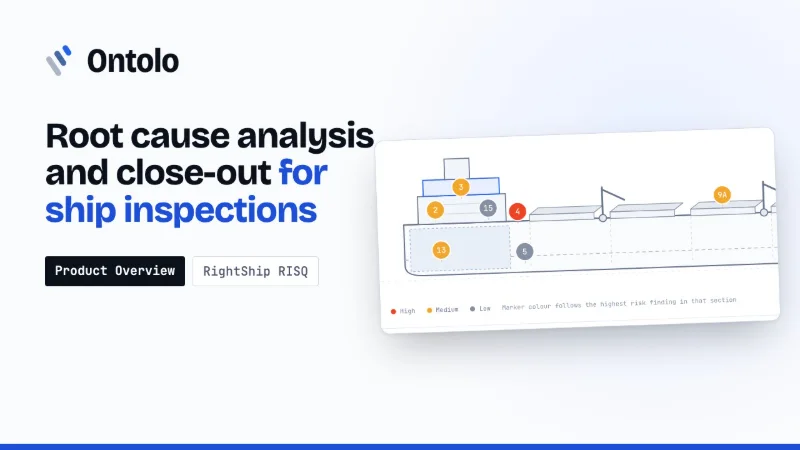
Root cause analysis and close-out · For Ship Managers and Operators
Ontolo drafts the close-out from the ship's own safety management system, maintenance history and prior findings — so every sentence points at a document the DPA can open.
Prototype on synthetic data · design partners being recruited · Copenhagen
The answer is already in the ship's own records. Nobody has time to go and find it.
So here is one deficiency being answered — a fire main defect raised by a port state control officer in Rotterdam. Pick a part of the response; the checks alongside it are the ones that apply to that part.
Prototype. It runs on published Paris MoU deficiency records and a synthetic safety management system. Codes, field labels and the section order come from published scheme material. The vessel, the company and the people are invented, and the IMO number is outside any issued range.
How it works
Four moves, and a loop.
Findings arrive from several regimes in unharmonised language. They are reconciled against one structured record per ship, reasoned over, approved by a named person, and submitted. The grader's verdict comes back and stays with the record.
Inbound · unharmonised
01
New findings arrive
From port state control, RightShip, class and internal audits — different forms, different wording for the same defect, different deadlines. Each one is matched to the ship it belongs to and to findings already answered.
MV Guillemot · IMO 9421268
02
One record per ship
Assembled from the operator's own files however they arrive — scanned PDFs, Word procedures, Excel registers, maintenance exports. Document control travels with it, so the record knows which revision was in force on the date of the finding.
One agent per part
03
Reason over the record
One agent per part of the response. Immediate cause is kept apart from underlying cause, the same gap is checked across the sister ships, and every drafted sentence is proved against the document it cites — before a person ever sees the draft.
04
A named person approves
The DPA, QA lead or superintendent accepts or rejects each claim with the citation open beside it. Required by the EU AI Act and by the scheme's own guidance on AI-assisted tooling — and the only arrangement that belongs in a safety function.
Accepted, rejected, resubmitted, and the validity granted — the grader's verdict goes back into the record, so the next draft for that deficiency type knows what a grader actually accepted. Your own accepted responses set the standard, not a generic one.
The record
Everything the answer is drawn from.
One record per ship, assembled from documents the operator already holds. Nothing is drafted that these five layers cannot support.
The hard part
Three problems the reasoning has to solve.
None of them is solved by reading the inspection report. All three are solved, or not, in the vessel's own records.
01 · cross-regime equivalence
Is this the same defect, written up twice?
A port state officer and a vetting inspector describe one fault in different words, months apart. Answer it twice and the ship gets fixed twice, sometimes in contradictory ways, and the crew carries both jobs. How often findings across regimes actually restate each other is not published anywhere — we are measuring it on real fleets rather than assuming it.
02 · cause candidacy
Which record actually caused it?
Dozens of records mention the same equipment. Picking one that is merely related, rather than one that plausibly caused the fault, is how a close-out gets sent back. The scheme's own analysis of close-outs from technical managers found most of them labelled an immediate or intermediate cause as the root cause.
03 · faithfulness
Can every sentence be checked?
A grader rejects what cannot be verified. Every sentence has to point at a document the reviewer can open, at the revision in force — and the system has to prove that before a person ever sees the draft.
The company
Early, and openly so.
One vessel record. One response. Nothing else.
Ontolo is a Copenhagen startup building the tooling for inspection close-outs in ship management.
A finding lands from RightShip, port state control or an internal audit. Someone ashore then has to work out what actually went wrong, write a response the auditor will accept, and attach evidence that holds up. It is slow, it happens under a deadline, and it usually falls to one or two people who already have a full week.
Ontolo builds a single source of truth per vessel: inspection history, safety management system, planned maintenance schedule. On top of that record we run purpose-built agents for root cause analysis, corrective and preventive actions, and evidence guidance, drafting the finding response ready for your responsible person to approve. Nothing gets drafted that the vessel record cannot support, and every sentence points back to where it came from.
The loop closes on approval. As responses are accepted and rejected, Ontolo learns what a response that passes looks like for your fleet, on your regimes.
Stage
Early prototype. Design partnerships being set up now, rather than later.
Data
Synthetic and publicly available inspection records. No customer data in the system.
Team
One founder, in Copenhagen. You talk to him, not a support queue.
Design partners · five slots
Five operators, before anyone else.
We are looking for ship managers, in house or third party — and specifically the person who actually owns close-out work: DPAs, QA leads, superintendents.
If you own close-out work and you think this is either useful or wrong, both are worth thirty minutes. Being told it is wrong early is a good deal cheaper than finding out later. Book a call →
Our operating commitment
What we will not do with your documents.
Operators do not release the SMS lightly, and they are right not to. These are commitments written into the agreement, not settings.
Hosting
EU only
Data stays in the EU under a processing agreement per customer. SMS and maintenance records name crew, so GDPR applies.
Isolation
One environment per customer
No shared corpus. Your fleet's documents are not visible to any other tenant, at any layer.
Training
No customer document is trained on
Not by us and not by a model provider. Only de-identified accepted and rejected outcome labels are kept.
Oversight
A person approves every claim
Required by the EU AI Act and by the scheme's own guidance on AI-assisted tooling. Nothing is submitted without a human signature.
Contact
Talk to the person building it.
Every call goes to Sascha directly. What comes out of it is a sharper product.
Sascha Struwe, PhD
Founder · Copenhagen
Ex Business Architect and Change & Adoption Lead at WPP Enterprise Solutions MAP. PhD in B2B Service Innovation, Aalborg University.
Book a call